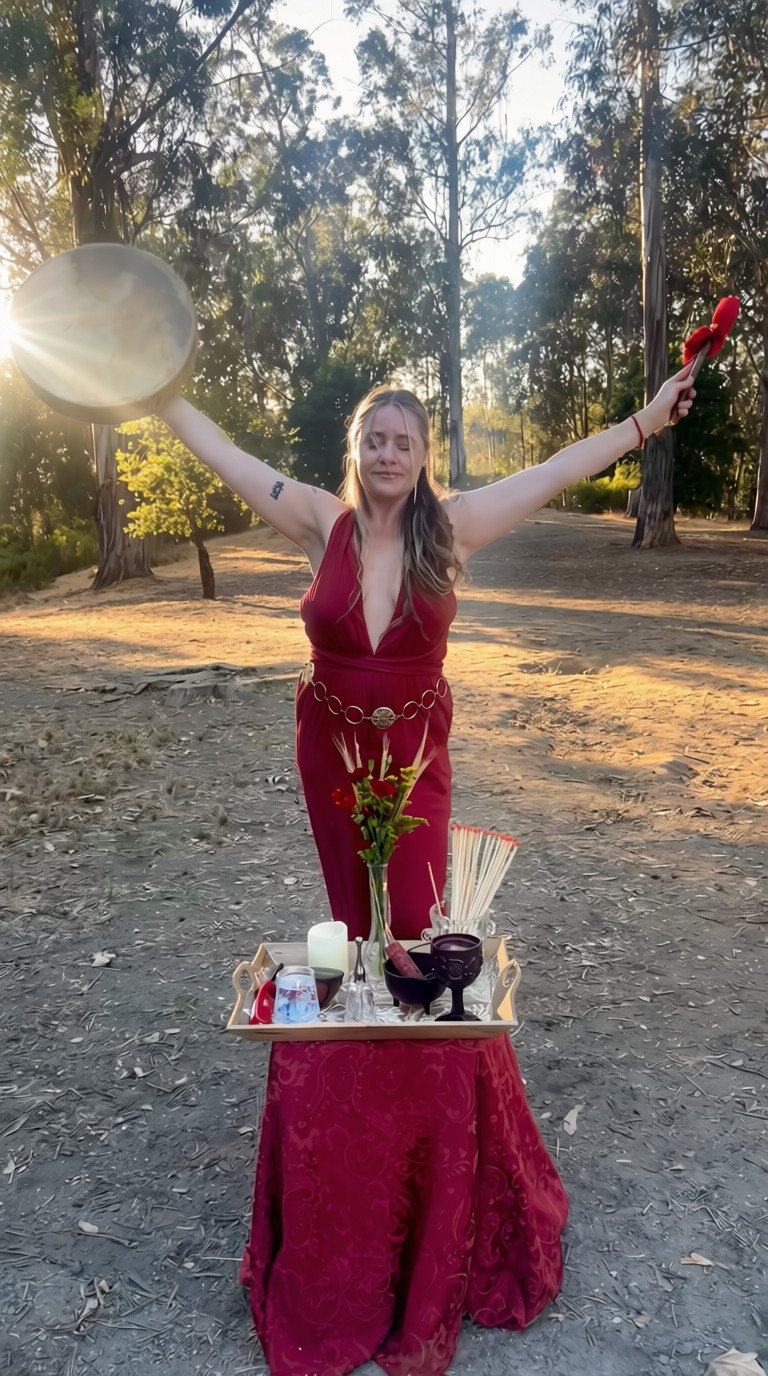
Amanda Yates is an ordained Priestess, ritualist, and Licensed Marriage and Family Therapist whose work brings together psychology, spirituality, embodiment, and sacred ritual.
Amanda first began practicing witchcraft at sixteen, beginning a relationship with occult and Earth-based spirituality that has spanned nearly twenty years. These practices became an important part of her own healing and taught her the power of living in relationship with the sacred and synchronizing with the rhythms and cycles of the Earth.
But some of her most transformative experiences happened in community. They happened in circle: singing together, grieving together, celebrating, witnessing others, and allowing herself to be witnessed in return.
Amanda believes deeply in the healing power of love, connection, healthy communication, and belonging. These are basic human needs, and many of us are desperately craving them in a culture that can be profoundly and painfully individualistic. There is inner work that only we can do for ourselves, but we were never meant to navigate every grief, transformation, initiation, or becoming alone.
A Calling to the Thresholds
Amanda has long been drawn to the thresholds of human life: death, birth, and all the portals in between.
Before becoming a therapist, she worked as a caregiver for people living with various forms of dementia. Being close to people at the end of life changed her relationship with death. She experienced a profound sanctity in the dying process and came to understand death, like birth, as a sacred threshold worthy of presence, reverence, meaning, and connection.
Her desire to more intentionally support people facing death eventually led her to psychedelic-assisted therapy. Amanda completed the Certificate in Psychedelic-Assisted Therapies and Research at the California Institute of Integral Studies and later served as a clinician and founding member of Ceremony Health, a ketamine clinic with an emphasis on healing and integration in community.
She believes the way we relate to death shapes the way we show up for life. When we bring connection, meaning, presence, and reverence to death and dying, we have an opportunity to change not only our individual relationship with mortality, but some of the fear and stories about death that we carry collectively.
And physical death is only one kind of ending.
We experience many deaths and births within a single lifetime.
Relationships begin and end. Identities fall away. Our bodies change. We become parents, partners, caregivers, seekers, survivors, elders, and versions of ourselves we couldn't have imagined before becoming them. Sometimes an old way of being ends before we have any idea what comes next.
Amanda is drawn to these in-between places. The portals where something has ended, something new is beginning to emerge, and we don't quite know who we'll be on the other side.
Psychology, Embodiment & the Unconscious
Amanda has practiced as a psychotherapist for ten years. Much of her work centers on helping people deepen their connection with themselves and others, become more present in their lives, and move toward greater authenticity and empowerment.
Her training in Somatic Parts Work and Internal Family Systems-informed practice has given her a framework for approaching our inner worlds with curiosity, compassion, and openness. Rather than trying to get rid of difficult parts of ourselves, we can become curious about them, listen to them, and understand what they might be trying to communicate.
Amanda is especially fascinated by the language of the unconscious, which often speaks through emotion, sensation, image, symbol, and metaphor.
Ritual can shift us out of our usual ways of thinking and invite us into a more symbolic and embodied way of knowing. It gives us an opportunity to listen differently, beyond intellect alone.
Her understanding of embodiment and non-ordinary states of consciousness has also been shaped by a 200-hour Vinyasa yoga teacher training with Ajarya Yoga in Rishikesh, India, where she studied movement, meditation, and breathwork. Her later training and clinical work in psychedelic-assisted therapy further deepened her interest in symbolism, mystical experience, non-ordinary states, and the ways we make meaning from profound experiences.
These experiences inform how Amanda holds sacred space with curiosity and respect for whatever may arise, whether it is emotional, embodied, symbolic, spiritual, or difficult to name. Ritual Healing Arts is separate from her clinical work and does not offer psychotherapy or psychedelic-assisted therapy.
Priestesshood as Service
Amanda's call to Priestesshood grew from a dedication to service and from realizing the reciprocal nature of service. When we tend one another, our communities, the Earth, and the sacred, we are changed by those relationships too.
Following three years of Priestess training and initiation, Amanda was ordained in the Sisterhood of the Moon Tradition, a matriarchal, Goddess-based tradition.
Her years in ritual community made her increasingly passionate about sharing what she had found there beyond the Pagan communities where she first experienced it. The practice of gathering in circle, marking the seasons, synchronizing with the Earth, creating ritual, and witnessing one another felt too meaningful to her to belong only to people who already called themselves Pagan or Witch.
Amanda believes ritual is part of our shared human inheritance. You don't need to identify as Pagan or Witch, believe in a particular deity, or even have a clear idea of what “the sacred” means to you to enter into ritual with curiosity and discover what it means for yourself.
For Amanda, Priestesshood is not simply a title. It is a commitment to tending sacred space in service of others.
Why Ritual Healing Arts
Ritual Healing Arts grew from Amanda's desire to create a place where these different parts of her life could speak to one another.
Psychological insight can sit beside myth and magick. The body gets to participate alongside the mind. We can pay attention to the cycles of the Earth and the movements of our own inner worlds. Deity can be experienced as sacred presence, archetype, metaphor, mystery, or something else entirely.
And we can do it together.
Amanda creates participatory rituals. You aren't meant to simply watch something sacred happen in front of you. You might reflect, move, sing, create, journey, listen, offer something of yourself, witness someone else, or allow yourself to be witnessed. What happens in a ritual can't always be known beforehand. Part of the practice is making room to discover what it means to you.
Community isn't simply the setting in which ritual happens.
Relationship is part of the medicine.
In a culture that so often leaves us navigating life's most profound experiences privately, Amanda wants to create another possibility. A place to gather intentionally, tend one another with care, practice authentic connection, mark what matters, and remember what it feels like to belong.
Whether we're standing at an ending, a beginning, or somewhere in the mysterious space between, ritual gives us a way to honor the crossing.
Ritual doesn't give us all the answers. It creates a space in which we may hear ourselves, and one another, differently.